Introduction
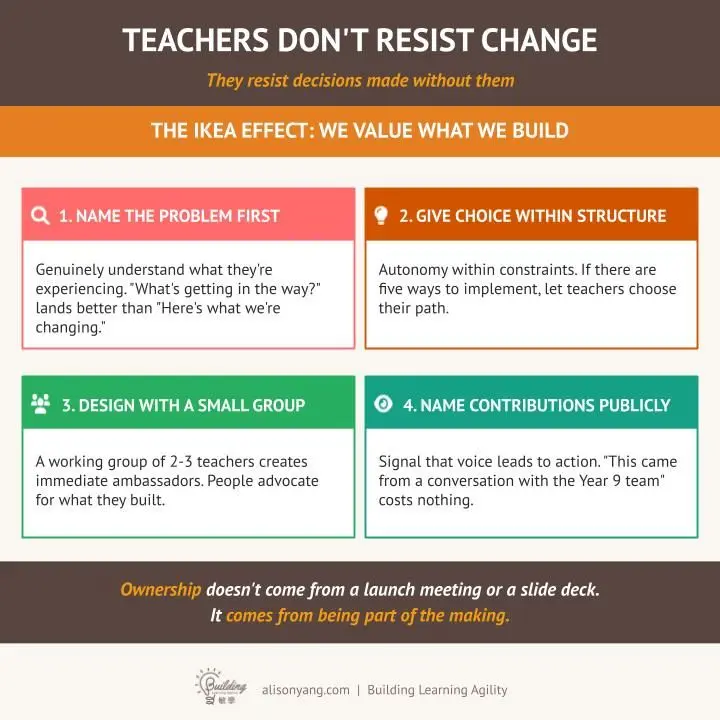
Anyone who’s built a plain IKEA bookshelf knows this feeling; you value it more because of the sweat equity you put into assembling it yourself. Even if a better-made version sat next to it, the one you helped create would still feel more worth keeping. That’s the IKEA Effect, a cognitive bias that explains a lot about how people respond to change.
The same pattern shows up in schools. Teachers don’t push back because they hate new ideas, better systems, or a clear plan. They push back when change arrives fully built, neatly packaged, and handed down with little space for their judgment, context, or voice. When teacher agency is absent from the start, resistance is the predictable result.
That difference matters. When educators help shape a decision, they see the why, spot the gaps, and feel responsible for making it work. In fact, the same kind of ownership that supports developing self-regulating learners also matters for adults in schools. Research from the OECD on teacher agency consistently shows that educators perform better and implement change more sustainably when they have genuine voice in decision-making.
So this isn’t really a story about resistance to change. It’s a story about ownership, trust, and teacher agency. In the rest of this post, you’ll see four practical ways school leaders can build that ownership first, so buy-in doesn’t have to be forced later.
What looks like resistance is often a lack of ownership
What leaders often call resistance is something quieter and more common, low investment. A teacher may not be fighting the idea at all. They may simply feel no real connection to a plan they did not help shape. This is what low teacher agency looks like in practice.
That matters because schools, amid pressures for standardized education, often roll out strong ideas with good logic, then wonder why the change only sticks on paper. When people miss the thinking behind the work, they tend to protect their energy and professional autonomy, do the minimum, and wait for the next initiative to replace it.
Why fully assembled initiatives rarely stick

Think about the difference between opening a flat-pack box and receiving finished furniture. This is known as the IKEA Effect. In the first case, you handle the parts, make sense of the steps, and solve small problems as you go. In the second, you just find a place for it.
School change works the same way. If a new reporting system, scripted curriculum, curriculum map, master schedule, or behavior policy arrives fully built, teachers only see the final product. They don’t see the trade-offs, the messy discussion, or the real constraints that shaped it.
As a result, the change can feel distant, even if the idea is sound. Teachers may use the new template, attend the training, and follow the rollout. Still, their adoption stays surface-level because the work never became theWhen teacher agency is missing from the process, surface-level adoption is the likely result.irs.
People support what they help build, especially when the work affects their daily practice.
Why compliance is not the same as commitment
Quiet compliance can look like success at first. The forms get filled out. The meetings happen. The required steps appear on calendars and planning documents.
But compliance only tells you that people know the expectation. It does not tell you they believe the change solves a real problem. When teachers privately experience a new process as one more thing done to them, they often comply in public and disconnect in practice. Low teacher agency shows up here: the gap between simple compliance and meaningful engagement widens.
You can see this in small ways. A schoolwide policy gets followed during walkthrough weeks, then fades. A new curriculum map is uploaded, but teachers keep using old materials. A reporting system goes live, yet staff treat it as admin work, not as a tool that helps learning.
In other words, rollout is not the same as culture change. Commitment shows up when teachers adapt the work, improve it, and carry it forward even when no one is checking. That kind of follow-through grows when people feel seen in the process, not just managed by it, leading to stronger student outcomes. Teacher agency is what makes that follow-through possible.
Start by asking teachers to name the problem
If leaders want real buy-in, they need to start earlier than most do. Not with a draft plan, not with a rollout deck, and not with a polished solution. Start with the problem. Just as inquiry-based learning empowers students by letting them explore and define challenges firsthand, leaders should ask teachers what they see, where students are getting stuck, and what keeps getting in the way. That simple shift changes the whole tone of change.
When people name the problem first, they don’t have to spend energy defending themselves against someone else’s answer. Instead, they can describe what is happening in plain terms, from the classroom up.
Better questions lead to better school decisions
A school can collect a lot of staff input and still miss the truth. That happens when the questions are too narrow or when the answer is already baked in. “What do you think of this new plan?” sounds open, but it often invites teachers to approve, edit, or reject something they never helped shape.
Better questions open the room instead of steering it. Through guided inquiry, leaders can ask:
- What’s getting in the way of strong learning right now?
- Where are students getting stuck most often?
- What routines create extra load without helping learning?
- What do you wish leaders understood about day-to-day classroom reality?
- Which problems feel urgent, and which ones just feel loud?

That is genuine inquiry, which gives teachers voice and choice in shaping the conversation. Performative consultation looks different. It asks for feedback after the path is set, then treats small edits as shared leadership. Teachers can tell the difference fast. One approach says, “Help us understand.” The other says, “Please bless this.”
The goal is not to confirm a pre-made answer. The goal is to see the problem clearly, with help from the people closest to it.
When teachers help define the issue, change feels more credible
People trust solutions more when the starting point sounds like their lived experience. If teachers have been saying that students struggle with unclear success criteria, weak feedback loops, or overloaded routines, they are far more likely to trust a response that grows from those realities.
That trust matters because ownership starts with diagnosis. A fair process does not ask teachers to react to a finished product and call that voice. It asks them to help frame the issue while the stakes are still open. As a result, the conversation gets more honest, and the heat comes down. Teachers are less defensive because they are not being cornered into agreeing. This is the foundation of real teacher agency in schools. When teacher agency grows here, so does trust.
This also improves the quality of the decision. Leaders get a better map of classroom reality, including the classroom environment teachers navigate every day, not just the view from meetings and reports. And when the problem statement reflects what teachers actually face, change feels less like a mandate and more like a shared response to a shared need. Strengthening teacher agency starts with how leaders frame the problem.
Give teachers real choice, even when the direction is set
Not every school decision can be built by committee. Leaders still have to set direction, protect priorities, and make calls that serve the whole school. Still, a clear direction does not require tight control over every move.
That middle ground is where trust grows. When teachers know the goal is fixed, but the path has room for judgment, change feels more professional and less imposed. Supporting teacher agency means giving direction while protecting space for professional judgment. In other words, structure gives clarity, and choice gives dignity. This mirrors the ownership of learning we want students to embrace.
Autonomy within limits still feels like autonomy
Choice does not have to mean unlimited freedom. Most teachers do not expect that. What they want is a real say in the parts that shape their daily work. Teacher agency means having real say, not unlimited freedom.
For example, a school might make one thing non-negotiable: every team will use common formative assessment tied to shared learning goals. That is the shared commitment. However, teams can still choose the assessment format, the timing, or how they review student work together.
That kind of design lowers friction because it answers two needs at once:
- Clear boundaries: People know what must happen.
- Meaningful options: People can decide how it happens in context.

Think of it like the frame of a house. The walls matter, but people still need freedom to arrange the rooms. If every detail is prescribed, teachers stop solving problems and start waiting for instructions. As a result, frustration rises, and ownership drops.
The goal is not total freedom. The goal is enough freedom to let professional judgment matter.
Small implementation choices can create big shifts in buy-in
Small choices often carry more weight than leaders expect because they signal trust. A teacher may not get to choose the why or the what, but choosing the how still matters. That is often enough to move a plan from compliance to commitment.
For instance, leaders might set a schoolwide goal around feedback, intervention, or planning consistency. Then teams can choose:
- Implementation routines, such as weekly check-ins or end-of-unit reviews
- Meeting structures, such as agenda order, note-taking roles, or protocols
- Assessment formats, such as quizzes, conferences, or performance tasks
- Instructional models, such as which one fits a specific unit
- Pacing choices, as long as teams stay within agreed checkpoints
These are not cosmetic choices. They shape workload, flow, and classroom fit. Because of that, they tell teachers, “Your judgment still counts here.” These elements also shape the classroom atmosphere to support student motivation.
The shift can be subtle at first. Staff stop asking, “Do we have to do this?” and start asking, “What’s the best way to do this well?” That is a very different kind of energy marked by greater engagement, and schools feel the difference fast.
Design with a small group first, then widen the circle
If you want stronger buy-in, don’t start with a whole-staff brainstorm. Start with a small working group. That sounds less democratic at first, but it usually leads to better co-design through a focused creative process, because the work stays honest and usable before it goes wider.
A good design team does more than react to a plan. It helps build the plan. That early stage matters because rough ideas need testing, not a room full of scattered opinions.
Why a small design team works better than asking everyone at once
Whole-staff input at the start often creates more noise than clarity. You get dozens of views, competing priorities, and very little agreement on what to do next. As a result, leaders can end up with pages of feedback and no workable draft.
A small group can do the slower, harder thinking first. It facilitates knowledge construction by spotting friction points, challenging weak assumptions, and turning broad concerns into decisions people can actually use. In other words, the team acts like a workshop bench, not a suggestion box. This approach shines for complex initiatives like curriculum development or shifting to project-based learning.

The key is who sits at the table. Don’t build the group around titles alone. Build it around real classroom credibility. Include teachers people trust, teachers who see daily constraints, and teachers who will raise concerns early instead of nodding along.
That kind of team also creates natural ambassadors. When the proposal goes to the wider staff, it arrives shaped by classroom reality, not just leadership intent.
How to avoid turning teacher voice into tokenism
Teacher voice becomes tokenism when staff are invited in after the main calls are already fixed. At that point, feedback can only polish the edges. People notice that fast, and trust drops with it.
Real co-design needs four things:
- A clear purpose, so the group knows what problem it is solving, such as curriculum development
- Visible influence, so teachers can see where their input changed the draft
- Protected time, so contribution is part of the work, not extra labor
- Honest revision, so feedback leads to actual change
Most importantly, widening the circle should happen after the working group has shaped something testable, but before leaders lock it in. That sequence tells staff their voice can still move the work. It also makes later consultation more useful, because people are responding to a thoughtful draft instead of a blank page.
When schools get this right, the group is not a token committee. It’s the place where practical design begins.
Publicly name teacher contributions so people can see voice led to action
If staff voice shaped a change, say so out loud. Don’t leave people guessing. A short line of credit helps teachers see that input did more than fill a survey or pad a meeting agenda.
That kind of naming also changes how the wider staff reads the initiative. It feels less like something delivered from above, and more like something built inside the school.
A simple sentence can build a lot of trust
Small phrases carry weight because they answer a quiet question teachers always ask, did anything happen because we spoke? When a leader says, “This came from conversations with the Year 9 team,” or, “This approach was shaped by teachers who piloted it last term,” it sends a clear signal. People can trace the idea back to real colleagues, real discussion, and real classroom experience.

That matters in school culture because trust grows through visible proof, not private intention. A named department, year-level team, or pilot group shows that teacher voice had a hand on the wheel, building self-efficacy. In turn, staff are more likely to see the new practice as grounded, tested, and worth taking seriously.
Recognition closes the loop between feedback and follow-through
When people can see what happened after they spoke, they are more likely to speak up again. That’s how you build psychological safety. Staff learn that offering honest views won’t disappear into a void, and that thoughtful feedback can shape the work. Publicly recognizing staff contributions boosts teacher motivation.
Public recognition also spreads responsibility in a healthy way. It tells the room, “This is ours.” As a result, future change gets stronger because more people expect to contribute, refine, and improve it. Over time, that habit builds a school where feedback serves as a reciprocal process between leaders and teachers, prompting reflection on the journey from input to results, and where change feels shared instead of imposed, ultimately supporting better student outcomes.
Conclusion
The IKEA Effect brings the whole point into focus; people are more likely to value what they help build. The same is true in schools. Ownership is not something a leader can announce in a staff meeting; it has to be built through the process, step by step. Building teacher ownership this way is the first step toward fostering student agency.
That is why the four actions matter. They promote active learning among staff. First, ask teachers to name the problem, so the work starts from real classroom experience. Next, give choice within clear limits, so direction stays steady while professional judgment still has room to work. Then design with a small group first, incorporating peer assessment so ideas get tested and improved before they spread. Finally, name teacher contributions in public, so staff can see that voice led to action.
When leaders use that kind of process, providing scaffolding to support teachers through change, it feels less like compliance and more like shared responsibility. As a result, trust grows, follow-through gets stronger, new practices have a better chance of lasting, and the result is empowered learners. Strong teacher agency is the engine behind all of it.
The IKEA Effect reminds us that if a change is not sticking, the question is simple: did teachers truly have a hand in making it? When teacher agency is built into the process, the answer becomes clear. This approach builds ownership of learning and improves student outcomes.